What Gets Sprayed
Four products, plain English, and honest guidance on which one your job actually needs.
Ask Which One You NeedHow This Differs From a Can
Aerosol rust sprays and brush-on rust paints have a place, and for a hinge or a bracket they are the sensible choice. What they cannot do is put enough material on the metal to matter.
A rattle can leaves 1 to 2 mils behind after the solvent flashes off. A brushed rust paint leaves 2 to 3 per coat. What gets sprayed here is 20 to 80 mils in one pass, and none of it evaporates — the products are 100% solids, so what leaves the gun stays on the steel.
The reason it can go on that thick without running is speed. Two components meet at the gun tip, mix, and start reacting immediately. Three to six seconds later the material has gelled and stopped moving. That is why you can spray the underside of a trailer frame at full thickness and nothing drips onto the shop floor.
It is also why you cannot brush it. There is no working time — nothing to dip a brush into. That part is genuinely a limitation, and it is why most small jobs get done by an applicator rather than in a home shop.
Thickness by Job
| Property | Value |
|---|---|
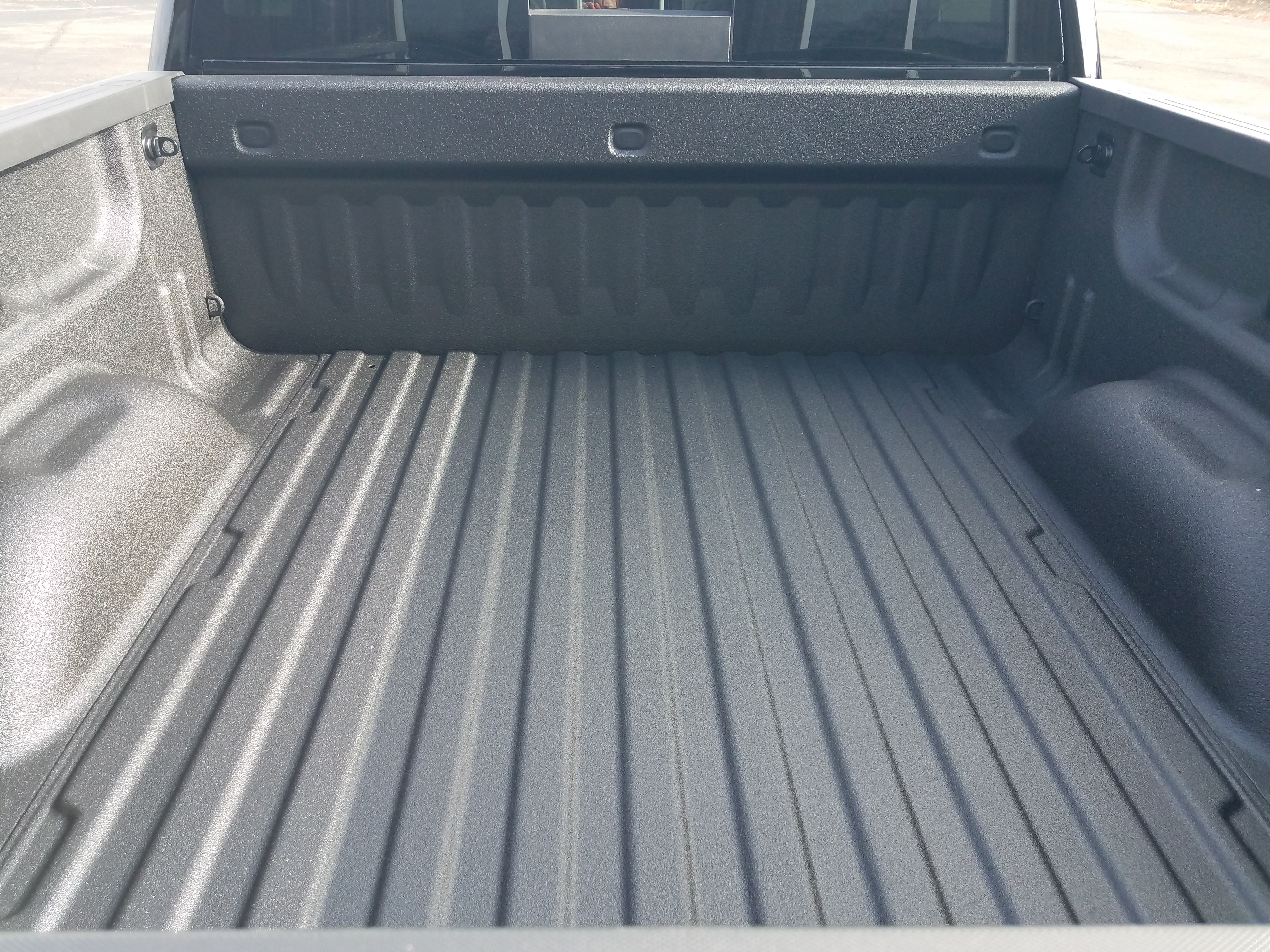
| Pickup bed floor & walls | FJ1 at 60 – 80 mil |
| Tailgate & bed rails | FJ1 at 60 mil |
| Truck frame & underbody | OR93BL at 30 – 40 mil |
| Rocker panels & wheel wells | OR93BL at 40 mil |
| Trailer steel deck | FJ1 at 60 – 80 mil |
| Trailer wood deck | 7001 primer + FJ1 at 60 mil |
| Trailer frame & crossmembers | OR93BL at 30 – 40 mil |
| Farm implement bodies | OR93BL at 40 mil |
| Spreader beds & contact faces | FJ1 at 60 – 80 mil |
| Loader buckets & chutes | Flak Jacket Pro at 80 – 120 mil |
| Gates, penning & feeders | OR93BL at 40 mil |
| Boat trailer frames | OR93BL at 40 mil, chlorides washed first |
| Tack-free | 10 – 30 seconds |
| Back in service | Usually under 1 hour |
| Coverage | 1,604 mil-sq-ft per gallon |
Picking Between the Three
OR93BL is the default. If the surface mainly needs to stop getting wet — frames, underbodies, implement bodies, gates, panels — this is what goes on, and it is the least expensive of the three per square foot.
Flak Jacket 1 (FJ1) is for surfaces that get used. Bed floors, trailer decks, anywhere loads get dropped or dragged or people stand. Higher build and tougher, so it takes the knocks that would eventually cut through a thinner film.
Flak Jacket Pro is for the parts where material actually grinds against the steel — loader buckets, chutes, spreader beds handling aggregate or fertilizer. It costs more and it is worth it only in those places. Do not let anyone put it on your whole trailer.
7001 primer goes underneath on wood decking, galvanized, and sound existing paint. It is brushable and rollable, so if you want to save some labour on the invoice this is the part you can do yourself the day before.
Most single-unit jobs use two of these — usually OR93BL on the structure and FJ1 where the work happens.
The Equipment Question, Answered Honestly
People ask regularly whether they can buy a kit and spray it themselves. Here is the straight version.
These products require a plural-component proportioner with a heated hose — Graco Reactor E-20 or E-30 class or equivalent — that heats both components to around 160°F and pushes them at roughly 2,000 PSI to a mixing gun. It is a serious piece of capital equipment, not a rental-counter item, and running it well takes practice.
For one trailer, one truck, or one implement, buying or renting your way into that makes no economic sense. Hiring an applicator who already has the rig hot and the material on board is cheaper, faster, and produces a better result.
Where it changes: if you are a farm with a yard full of implements, a small fleet operator, or a shop that does bodywork or fabrication, the arithmetic can flip. At that point talk to us about equipment before you spend anything — we do not sell rigs, so we have no reason to talk you into one.
Either way, the prep is yours if you want it. That is real money saved and it is work most people can do with tools they already own.
Want the Data Sheets?
We will send the TDS and SDS for whichever product suits your job, plus a plain-language prep checklist.
Request DocumentationFind Out What Your Job Takes
Tell us about your project and we will follow up with product details, technical data sheets, and pricing.